
South India rarely gets the spotlight it deserves in conversations about India’s UNESCO heritage. Ask most travelers to name an Indian World Heritage Site and they’ll say the Taj Mahal. Yet peninsular India — Tamil Nadu, Karnataka, Kerala, and the surrounding hill country — holds some of the subcontinent’s most extraordinary architectural and ecological treasures, several of which are still living, breathing places of worship rather than roped-off museum pieces.
South India is home to six UNESCO World Heritage Sites: five cultural and one natural. They span nearly a thousand years of temple-building history, from the granite shore temples of the Pallavas to the star-shaped soapstone marvels of the Hoysalas, and they include one of the world’s eight “hottest hotspots” of biological diversity in the Western Ghats. This guide walks through every one of them — where they are, why UNESCO recognized them, what makes them architecturally and culturally significant, and how to actually plan a visit.
Whether you’re building an India heritage itinerary, researching for a travel blog, or simply curious about what’s hiding in the temple towns of the south, this is your complete reference.
South India offers some of India’s most extraordinary architectural and cultural treasures, from ancient temples to historic cities and biodiverse mountain landscapes. Explore these remarkable destinations through our Private South India tour packages.
Quick Overview: UNESCO World Heritage Sites of South India
Group of Monuments at Mahabalipuram
State: Tamil Nadu
Year Inscribed: 1984
Category: Cultural
Great Living Chola Temples
State: Tamil Nadu
Year Inscribed: 1987 (extended 2004)
Category: Cultural
Group of Monuments at Hampi
State: Karnataka
Year Inscribed: 1986
Category: Cultural
Group of Monuments at Pattadakal
State: Karnataka
Year Inscribed: 1987
Category: Cultural
Sacred Ensembles of the Hoysalas
State: Karnataka
Year Inscribed: 2023
Category: Cultural
Western Ghats
State: Kerala, Tamil Nadu, Karnataka (and beyond)
Year Inscribed: 2012
Category: Natural
Five of these six sites are temple complexes built by three of South India’s greatest dynasties — the Pallavas, the Cholas, and the Hoysalas — plus the imperial capital of the Vijayanagara Empire at Hampi. The sixth, the Western Ghats, is a mountain range recognized not for what humans built, but for the extraordinary biodiversity that evolved there over millions of years.
Let’s go through each one in detail.
6 UNESCO World Heritage Sites of South India
1. Group of Monuments at Mahabalipuram, Tamil Nadu
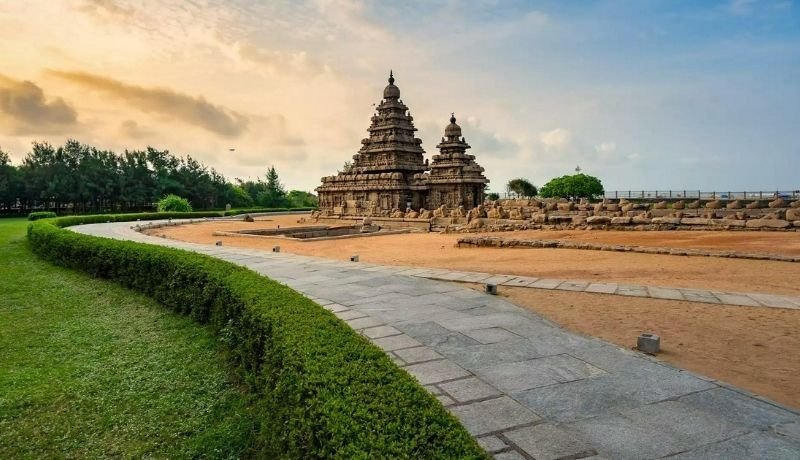
Location: Mahabalipuram (also called Mamallapuram), about 60 km south of Chennai, on the Coromandel Coast Inscribed: 1984 Built by: The Pallava dynasty, 7th–8th century CE
Mahabalipuram was once one of the busiest ports on India’s eastern seaboard, a place where ships from Southeast Asia, China, and beyond docked to trade. The Pallava kings who ruled here left behind an open-air workshop of rock-cut architecture that still astonishes engineers and art historians today.
What you’ll see
The Shore Temple is the site’s most photographed landmark — a granite structure standing directly on the beach, its silhouette worn smooth by more than a thousand years of sea spray. It’s actually a complex of three shrines, two dedicated to Shiva and one to Vishnu, built during the reign of King Narasimhavarman II (Rajasimha). Unlike most Hindu temples of the era, it was carved from built masonry rather than cut from a single rock face, making it structurally distinct from the rest of the site.
Arjuna’s Penance (also known as the Descent of the Ganges) is one of the largest open-air bas-relief rock carvings in the world, stretching nearly 30 meters across a natural granite boulder. It depicts a crowded, lively scene of gods, sages, elephants, and celestial beings, and scholars still debate whether it illustrates the story of Arjuna’s penance from the Mahabharata or the descent of the river Ganga to earth — possibly both, layered into a single composition.
The Pancha Rathas (Five Rathas) are five monolithic temples, each carved from a single piece of granite, shaped to resemble chariots (rathas) and named after the five Pandava brothers and their wife Draupadi from the Mahabharata. What makes them remarkable is that each one is a different architectural style, almost as if the Pallava sculptors were experimenting with design templates that would later mature into the temple architecture we see across South India.
The Cave Temples, cut directly into hillsides, contain some of the earliest surviving examples of structural experimentation in Dravidian temple design, including the Mahishasuramardini Cave, which depicts the goddess Durga slaying the buffalo demon.
Why it matters
Mahabalipuram is essentially a textbook of early Dravidian architecture, showing the transition from rock-cut caves to free-standing structural temples. Almost every major South Indian temple style that followed — the towering gopurams, the pillared halls, the temple tanks — has roots that can be traced back to techniques pioneered here.
Visiting tips
- Best visited early morning to avoid crowds and the coastal heat.
- The site is compact enough to cover on foot in half a day, though a full day lets you also visit the nearby Tiger Cave and the Crocodile Bank.
- Combine it with a short trip to Chennai (about 1.5–2 hours by road), making it an easy day trip.
- October to March offers the most comfortable weather.
2. Great Living Chola Temples, Tamil Nadu
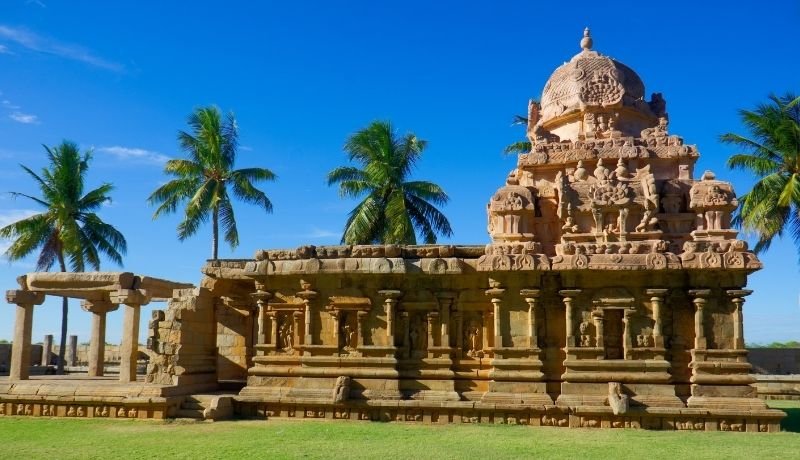
Location: Three separate sites — Thanjavur, Gangaikondacholapuram, and Darasuram — all in Tamil Nadu Inscribed: 1987 (Brihadishvara Temple at Thanjavur); extended in 2004 to include the other two temples Built by: The Chola dynasty, 11th–12th century CE
The name “Great Living Chola Temples” is deliberate — these aren’t ruins. They are active places of Hindu worship where rituals have continued, largely unbroken, since they were built nearly a thousand years ago. UNESCO recognizes them collectively because together they trace the evolution of Chola temple architecture at its peak.
The three temples
Brihadishvara Temple, Thanjavur is the crown jewel. Built by Raja Raja Chola I and completed around 1010 CE, its vimana (tower over the sanctum) rises about 66 meters, making it one of the tallest temple towers in India — remarkable given it was built over a thousand years ago without modern engineering tools. The temple is constructed almost entirely from granite, a material not naturally found near Thanjavur, meaning the stone had to be transported from significant distances. A single granite block, weighing an estimated 80 tonnes, forms the capstone (shikhara) atop the tower — how it was lifted into place remains a subject of engineering fascination. The temple walls are covered with Chola-era frescoes and inscriptions that have provided historians with invaluable records of the empire’s administration, art, and daily life.
Gangaikondacholapuram Temple, built by Raja Raja Chola’s son, Rajendra Chola I, roughly a century later, was constructed to commemorate his military campaigns and the founding of a new Chola capital. It largely mirrors the architectural grammar of the Thanjavur temple but with refinements — the tower has a gentler, more curved profile, and the sculptural work shows a maturing of the Chola artistic style.
Airavatesvara Temple, Darasuram, built by Rajaraja Chola II in the mid-12th century, is smaller in scale but denser in ornamentation. It’s known for its exceptionally detailed stone carvings, including a stone chariot design at the entrance and a stone staircase carved to resemble musical steps that reportedly produce different notes when struck.
Why it matters
Together, these three temples chart nearly 150 years of Chola architectural evolution — from the ambitious scale of Thanjavur to the refined intricacy of Darasuram. They’re also significant for the Chola bronze sculpture tradition; the famous Nataraja (dancing Shiva) bronzes, among the most celebrated works of Indian art, were cast and used in the ritual life of temples like these.
Visiting tips
- Thanjavur is the most accessible base, well connected by rail and road from Chennai, Trichy, and Madurai.
- Gangaikondacholapuram is about 70 km from Thanjavur; Darasuram is much closer, around 35 km.
- Plan two days if you want to see all three sites without rushing.
- Thanjavur is also home to the excellent Saraswathi Mahal Library and the Thanjavur Palace, worth combining into your visit.
- Early morning visits let you see the temple during active rituals, which adds a layer of experience you won’t get from photographs.
Together, these temples offer an excellent opportunity to experience the architectural and cultural legacy of the Chola dynasty through a South India Tour.
3. Group of Monuments at Hampi, Karnataka
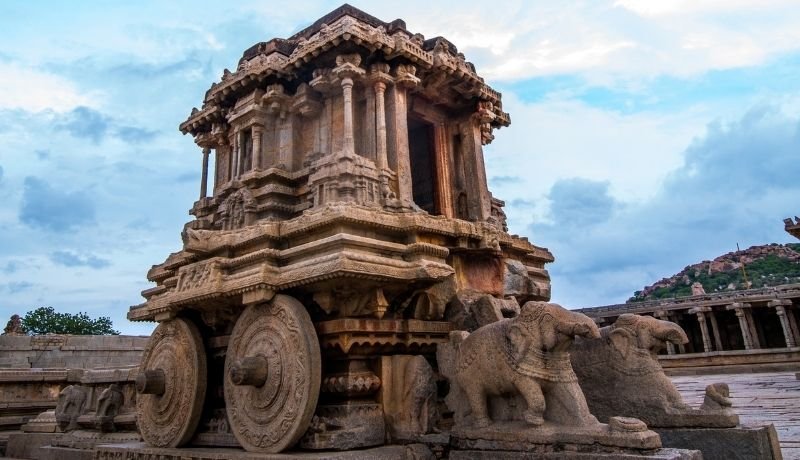
Location: Hampi, on the banks of the Tungabhadra River, Ballari district, Karnataka Inscribed: 1986 Built by: The Vijayanagara Empire, 14th–16th century CE
Hampi isn’t a single temple — it’s the sprawling ruined capital of the Vijayanagara Empire, once one of the largest and wealthiest cities in the medieval world. Portuguese and Persian travelers who visited in its heyday described a city of extraordinary opulence, with markets trading in diamonds and horses shipped from Arabia. What survives today is a boulder-strewn landscape scattered with temples, royal enclosures, market streets, and elephant stables across an area of roughly 40 square kilometers.
What you’ll see
Virupaksha Temple, dedicated to Shiva, is the spiritual heart of Hampi and — unlike most of the site — still an active place of worship, with a history predating the Vijayanagara Empire itself. Its towering nine-tiered gopuram is visible from much of the surrounding landscape.
The Vittala Temple Complex is Hampi’s architectural showpiece, home to the iconic stone chariot (a shrine carved to resemble a temple chariot, now something of an unofficial symbol of Karnataka tourism) and the famous “musical pillars” — columns that are said to produce different musical notes when tapped, carved from single blocks of granite.
The Royal Enclosure and Zenana Enclosure contain the remains of the palace complex, including the Lotus Mahal (a pavilion blending Hindu and Islamic architectural styles) and the elephant stables, an eleven-domed structure built to house the royal ceremonial elephants.
Hazara Rama Temple, once the private temple of the royal family, is covered in relief panels depicting scenes from the Ramayana.
Beyond the monuments, Hampi’s setting is itself part of its appeal — a surreal landscape of giant boulders balanced against each other, rice paddies, and the Tungabhadra River winding through it all.
Why it matters
Hampi represents the last great flowering of a Hindu empire in South India before the region came under sustained pressure from the Deccan sultanates, who sacked the city in 1565. Its architecture blends Dravidian temple traditions with Indo-Islamic elements absorbed through centuries of contact and conflict with neighboring sultanates — a fusion you can see clearly in structures like the Lotus Mahal.
Visiting tips
- Hampi is best explored over two to three days; the site is too large to see meaningfully in a single day.
- Renting a bicycle or moped is the most popular way to get around, though auto-rickshaws and guided tours are widely available.
- The nearest railway station is Hospet (Hosapete), about 13 km away, well connected to Bengaluru and Hyderabad.
- November to February offers the most pleasant weather; summers are extremely hot.
- Sunset at Hemakuta Hill or Matanga Hill, overlooking the ruins, is a highlight most visitors don’t want to miss.
Travelers can also include Hampi in a longer Karnataka cultural tour.
4. Group of Monuments at Pattadakal, Karnataka
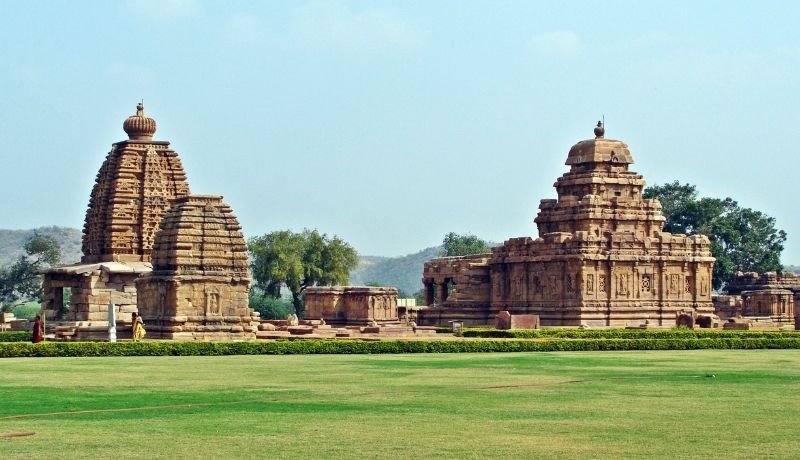
Location: Pattadakal, on the banks of the Malaprabha River, Bagalkot district, Karnataka Inscribed: 1987 Built by: The Chalukya dynasty, 7th–8th century CE
Pattadakal is smaller and less visited than Hampi, but arguably just as important architecturally. It served as the ceremonial coronation site for the Chalukya kings, and its temples represent a unique moment in Indian architectural history: a deliberate fusion of North Indian (Nagara) and South Indian (Dravidian) temple styles, built side by side within a single complex.
What you’ll see
The site contains ten major temples, the most significant being the Virupaksha Temple, built around 740 CE by Queen Lokamahadevi to commemorate her husband King Vikramaditya II’s victory over the Pallavas of Kanchipuram. It’s built in the Dravidian style and is thought to have directly influenced — or been influenced by — the Kailasa Temple at Ellora in Maharashtra, given the close historical ties between the two dynasties.
Nearby, the Papanatha Temple shows a fascinating blend of both Nagara and Dravidian elements within a single structure, almost as if the builders were experimenting with combining northern and southern architectural vocabularies.
Other notable structures include the Mallikarjuna Temple, Sangameshwara Temple, and Jain Narayana Temple, each showing slightly different stages of this stylistic synthesis.
Why it matters
Pattadakal is often described by architectural historians as a meeting point of North and South Indian temple design — a rare, physical record of two major Indian architectural traditions developing in dialogue rather than isolation. This is precisely why UNESCO recognized it: not just for the beauty of individual temples, but for what the site as a whole reveals about the cross-pollination of ideas across the subcontinent during the Chalukya period.
Visiting tips
- Pattadakal is often combined with nearby Badami and Aihole (both important Chalukyan sites, though not themselves UNESCO-listed), forming a well-known heritage circuit in northern Karnataka.
- The nearest major town is Badami, about 22 km away, which has more accommodation options.
- The nearest airport is Hubli, roughly 120 km away; Bengaluru is a longer but more connected option.
- Winter months (November–February) are ideal; this part of Karnataka gets very hot in summer.
- A single day is usually enough for Pattadakal itself, but plan two to three days if combining it with Badami and Aihole.
5. Sacred Ensembles of the Hoysalas, Karnataka
Location: Three temple towns — Belur, Halebidu, and Somanathapura — in Karnataka Inscribed: 2023, making it India’s most recent South Indian addition to the list at the time (and its 42nd World Heritage Site overall) Built by: The Hoysala dynasty, 12th–13th century CE
This is the newest UNESCO World Heritage Site in South India, inscribed in September 2023 after being on the tentative list since 2014. It’s also, for many visitors, the most visually astonishing — the Hoysala sculptors achieved a level of stone-carving detail that borders on the hyper-realistic, and it’s genuinely hard to believe some of these details were chiseled by hand into hard soapstone.
The three temples
Chennakeshava Temple, Belur, built in 1117 CE by King Vishnuvardhana, is dedicated to Vishnu and remains an active temple to this day, sitting inside a walled complex with a temple tank, right at the center of Belur town. It’s celebrated for its intricately carved bracket figures (madanikas) — sculpted female figures shown in dance poses, jewelry rendered in astonishing detail, down to individually carved beads.
Hoysaleswara Temple, Halebidu, built around 1160 CE and dedicated to Shiva, sits on the banks of the Dorasamudra tank. Its outer walls are covered, nearly floor to ceiling, in continuous friezes depicting elephants, lions, horsemen, scenes from the Ramayana and Mahabharata, and mythological narratives — an approach to surface decoration that has no real parallel elsewhere in Indian temple architecture.
Keshava Temple, Somanathapura, the latest of the three, completed in 1258 CE, is a trikuta (three-shrined) temple dedicated to Vishnu in three forms — Janardhana, Keshava, and Venugopala. Sadly, the original Keshava idol is missing and the other two are damaged, likely from historical invasions, but the architecture and surrounding sculptural gallery remain remarkably intact.
What defines the Hoysala style
All three temples share a distinctive stellate (star-shaped) ground plan, built on raised platforms, using soapstone (chloritic schist) as the primary material — a softer stone than the granite used further south, which allowed for far finer, almost jewelry-like detail. Look closely and you’ll find multi-tiered friezes running around the temple base depicting, in ascending order, elephants (symbolizing strength), lions (courage), horses (speed), and scenes from Hindu epics — essentially a visual narrative wrapped around the entire building.
Why it matters
UNESCO’s inscription recognized the Hoysala style as a genuinely distinctive architectural language — not simply a regional variant of Dravidian temple design, but its own tradition, shaped by the Hoysala rulers’ desire to distinguish their temples from those of neighboring kingdoms. The level of sculptural detail achieved here is frequently cited by art historians as among the finest in all of Indian temple architecture.
Visiting tips
- Belur and Halebidu are close to each other (about 16 km apart) and easily combined in a single day.
- Somanathapura is farther, closer to Mysuru (about 35 km), and pairs well with a Mysuru-based itinerary.
- The nearest major airport is Bengaluru (around 200 km to Belur/Halebidu), though Mysuru airport is closer if you’re starting from Somanathapura.
- Given the newness of this inscription, expect infrastructure and visitor facilities to keep improving in the coming years — but also expect fewer crowds than at more established sites like Hampi, for now.
- Early morning light is particularly good for photographing the intricate carvings, which are best appreciated up close.
6. Western Ghats
Location: A roughly 1,600 km mountain chain running along India’s western coast, spanning Gujarat, Maharashtra, Goa, Karnataka, Kerala, and Tamil Nadu. The UNESCO-inscribed serial site covers 39 component parts, concentrated heavily in Kerala, Tamil Nadu, and Karnataka. Inscribed: 2012 Category: Natural
The Western Ghats is the one entry on this list that isn’t about temples or empires — it’s about deep ecological time. Older than the Himalayas, the Western Ghats are recognized by UNESCO, and by conservation scientists globally, as one of the world’s eight “hottest biodiversity hotspots,” and they directly influence the monsoon weather patterns that much of peninsular India depends on.
What makes it exceptional
The range is home to an extraordinary concentration of endemic species — plants and animals found nowhere else on Earth. This includes over 5,000 species of flowering plants, several hundred species of birds, and iconic mammals like the Nilgiri tahr, lion-tailed macaque, and Asian elephant, alongside a significant population of Bengal tigers.
The southern stretches of the Ghats, running through Kerala and Tamil Nadu, include some of the most ecologically significant protected areas in the region: the Periyar Tiger Reserve, the Silent Valley National Park (one of the last surviving tracts of undisturbed tropical evergreen forest in India), the Nilgiri Biosphere Reserve, and the Agasthyamalai Hills on the Kerala–Tamil Nadu border.
Unlike the temple sites on this list, the Western Ghats is a “serial” World Heritage property — meaning it’s not one continuous protected area but a collection of individually significant sites recognized together because of their combined ecological value.
Why it matters
The Western Ghats intercept the southwest monsoon, making them critical to the water supply and climate stability of much of South India. UNESCO’s inscription specifically noted the region’s exceptional levels of plant and animal endemism, its role as a genetic reservoir, and the presence of species considered globally threatened. For a country as biodiverse as India, having a natural World Heritage Site of this scale in the south is a significant recognition of the region’s ecological importance — not just its human history.
Visiting tips
- Because the Western Ghats span multiple states and dozens of protected areas, “visiting” typically means choosing a specific component rather than the whole range.
- Popular and accessible entry points include Munnar and Periyar (Thekkady) in Kerala, the Nilgiri Hills (Ooty, Coonoor) straddling Tamil Nadu, and Kudremukh and Bandipur in Karnataka.
- Wildlife sightings are generally best in the early morning or late afternoon, and during the drier months from December to April.
- Many of the reserve areas require permits or guided entry, particularly for trekking and wildlife safaris — it’s worth booking in advance during peak season (December–February).
- The monsoon months (June–September) transform the landscape dramatically and are popular for waterfall viewing, though some trekking routes and safaris may be restricted.
Planning a Trip of UNESCO World Heritage Sites of South India
If you’re trying to build all six sites into a single trip, a few practical notes will help:
Group by state and geography, not by chronology. Mahabalipuram and the Great Living Chola Temples pair naturally together in Tamil Nadu, connected by road through Chennai, Thanjavur, and the surrounding temple towns. Hampi, Pattadakal, and the Sacred Ensembles of the Hoysalas can be strung together across Karnataka, though Hampi sits in the north of the state while Belur, Halebidu, and Somanathapura are in the south — so this typically requires two separate legs of a Karnataka itinerary rather than one continuous loop. The Western Ghats can be woven in wherever your route passes through Kerala, the Nilgiris, or the Karnataka hill country.
Budget realistic time per site. Mahabalipuram and Pattadakal can each be covered comfortably in a day. The Great Living Chola Temples and the Sacred Ensembles of the Hoysalas benefit from two days each, since their components are spread across nearby towns. Hampi genuinely needs two to three days to do justice to its scale. The Western Ghats could absorb an entire trip on their own, depending on how much wildlife viewing and trekking you want to do.
Season matters more here than in North India. Most of South India’s dry, comfortable travel window runs from October through March, with November to February being the sweet spot for temple visits. The Western Ghats are an exception — the monsoon season (June–September) is when the hills are at their greenest, though it can complicate travel to more remote trekking areas.
Respect that these are living heritage sites. Unlike many World Heritage monuments elsewhere in the world, several of these — the Brihadishvara Temple, the temples of Belur and Halebidu, Virupaksha Temple at Hampi — remain active places of worship. Dress modestly, be mindful during rituals, and check local customs around footwear and photography before entering sanctum areas.
Final Thoughts – UNESCO World Heritage Sites of South India
UNESCO World Heritage Sites of South India tell a story that spans nearly two thousand years — from the Pallava sculptors who first began carving structural temples out of granite boulders at Mahabalipuram, through the imperial ambition of the Cholas at Thanjavur, the architectural experimentation of the Chalukyas at Pattadakal, the artistic peak of the Hoysalas at Belur and Halebidu, and the sprawling, cosmopolitan wealth of the Vijayanagara Empire at Hampi — set against the backdrop of the Western Ghats, a mountain range that has been quietly shaping the region’s climate and biodiversity for far longer than any human civilization has existed there.
For travelers and heritage enthusiasts alike, these six sites offer something North India’s more famous monuments often can’t: temples that are still alive with ritual, architecture still evolving through active scholarly discovery (as with the Hoysala inscription in 2023), and a natural landscape recognized not as a backdrop to human history, but as a wonder in its own right.
If you’re planning your own heritage trail through South India, this list is a solid place to start — but each of these sites rewards more than a single visit.
FAQs – UNESCO World Heritage Sites South India
1. Can you visit multiple UNESCO World Heritage Sites in South India on one trip?
Yes. You can plan a multi-destination heritage tour covering several UNESCO World Heritage Sites in South India. A practical route is to group sites by region, such as Mahabalipuram and the Chola temples in Tamil Nadu, or Hampi, Pattadakal, and the Hoysala temples in Karnataka. Depending on how many sites you want to explore, allow at least 10 to 14 days for a more relaxed itinerary.
2. Which South Indian UNESCO World Heritage Site is best for first-time visitors?
For first-time visitors, Hampi and Mahabalipuram are excellent choices because they offer a combination of history, impressive architecture, and relatively easy sightseeing. Hampi is ideal for travelers who want to explore a vast ancient city, while Mahabalipuram is better suited to those looking for a shorter heritage experience near Chennai.
3. Are UNESCO World Heritage Sites in South India suitable for family trips?
Yes, many UNESCO World Heritage Sites in South India are suitable for families. Mahabalipuram, Hampi, and the Great Living Chola Temples are particularly good for travelers interested in combining sightseeing with cultural experiences. However, larger sites such as Hampi involve considerable walking, so families traveling with young children or elderly visitors should plan a comfortable sightseeing schedule.
4. Do you need a guide to visit UNESCO World Heritage Sites in South India?
A guide is not essential at every site, but it can significantly improve your experience, especially at historically complex destinations such as Hampi, Pattadakal, and the Hoysala temples. Many monuments contain detailed carvings, religious symbolism, and historical features that can be difficult to understand without context. A knowledgeable guide can help explain the architecture, stories, and cultural significance behind what you are seeing.